Products
-

2024 FASA Annual Report
R0.00 -
2023 Franchisor Survey
R1,500.00 -
2024 FASA Franchise Manual
R420.00


The power of franchising…to provide employment

Our new world of technology which, whilst offering great opportunities through technological advances and new business opportunities, also presents challenges that can be quite devastating – with job security one of the key areas of concern. In South Africa greater income inequality, increased unemployment, growing dependence on government, and more mass migrations are a few of the most pressing problems that failing to train the next generation of workers for the digitally driven economy will result in – let alone simply providing jobs for the overwhelming number of unemployed, especially the youth which has reached almost 60%.
Entrepreneurship is one of the driving forces of economic growth in any economy as it fuels innovation that in turn provides skills training, stimulates small business development and ultimately creates employment. Franchising’s success in employment creation takes it a step further in that a franchise system that develops a brand and spreads its success through the proliferation of franchisees, not only adds to direct employment but also to indirect employment through the supply chain that supports a growing franchise entity.
FASA would like to see government give more support to the positive role that franchising can play in stimulating the small business sector and also appeals to big business to look at the potential of using the franchise format as an expansion mechanism.
With Government committed to allocating large training and empowerment funds to be utilized for improving the plight of the majority of South Africans, FASA has partnered with INANI and embarked on getting professional qualifications approved, developed and registered and has been working with the Services Seta in the development of qualifications for the franchising sector.
- The unemployment rate in South Africa increased from 23, 3% in the second half of 2020, just after the onset of the COVID-19 pandemic to 32,9% in January 2023.
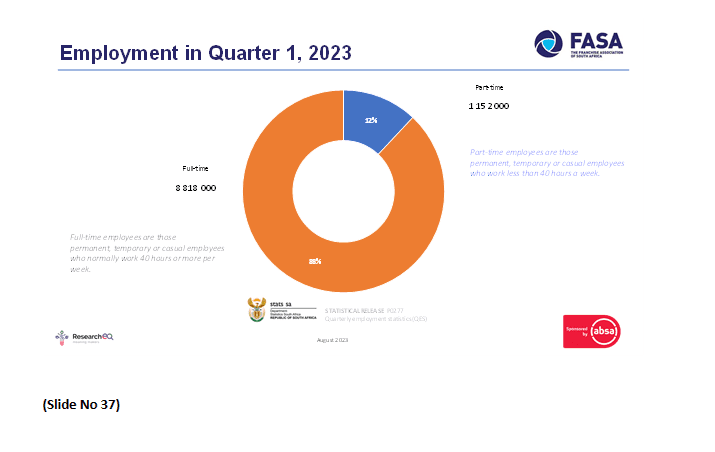
- According to Stats SA, there were 8 818 000 full-time and 1 152000 part-time employees in South Africa in the first quarter of 2023. Based on these numbers, it appears that the franchise sector accounts for an estimated 4, 7% of employment in this country, which translates into an estimated 471 233 employees.
- In each franchised outlet, there are 24 [17] staff members, including the franchisee him/herself; 21 [15] of these employees are full-time staff members and 3 [2] are part-time employees; 2, 2 [2, 5] are management and 14, 5 [15, 7] are non-management, the average ratio between management and staff being 1: 7.
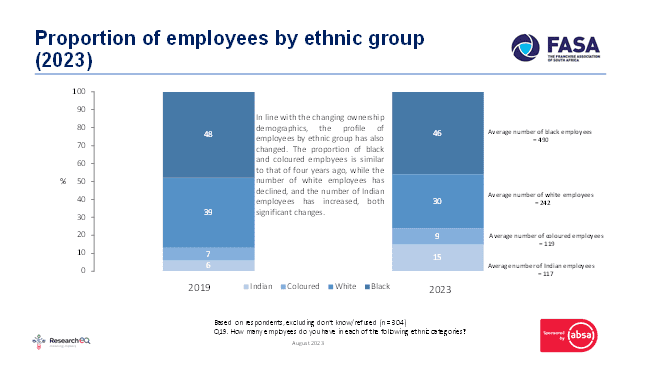
- Black employees made up the largest proportion of staff members in franchisee outlets. The employee ratios were 60 black: 20 white: 9 coloured: 11 Indian. The average number of black employees increased from 11, 9 to 14, and 4.
- In an average franchise system, 8, 5% are franchise management, 38, 3% are franchisor staff, 7, 7% are franchisee management and 45, 5% are franchisee staff.



To protect, lobby, promote and develop ethical franchising across all sectors in South Africa with specific focus on transformation.